
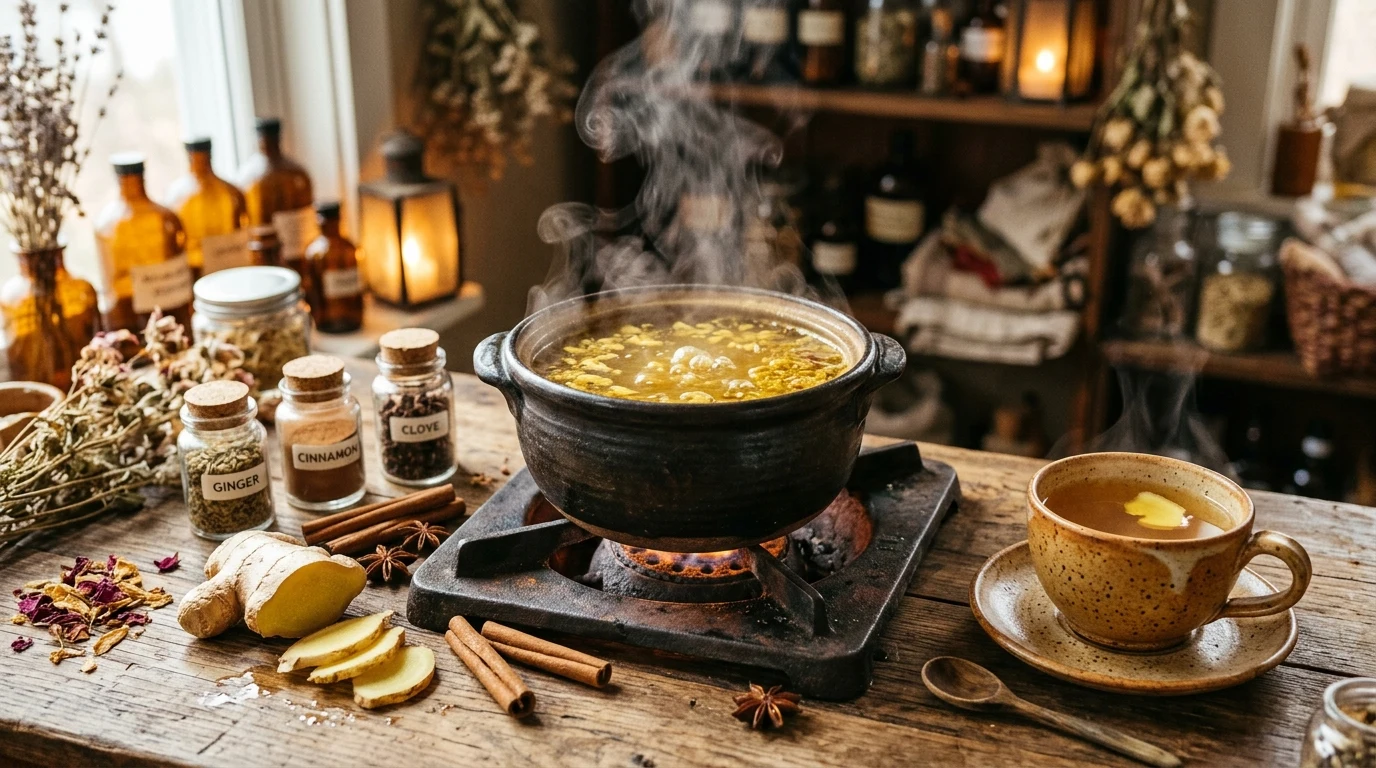
How to Make a Ginger Decoction: Science, Recipe, and Health Benefits
✨ This article was AI edited. Editorial responsibility: GarlicFruit.com.
Understanding how to make a ginger decoction unlocks the full pharmacological and therapeutic potential of fresh and dried ginger rhizomes (Zingiber officinale). While standard herbal infusions (steeping in boiled water) suffice for delicate leaves and flowers, dense, woody, fibrous roots require the sustained thermal energy of a covered decoction to break open thick cell walls, gelatinize internal starches, and fully extract deep bioactive gingerols, shogaols, and zingerone.
Contents
Decoction vs. Infusion: The Extraction Science of Woody Rhizomes
In clinical herbalism and pharmacognosy, plant tissues are categorized by cellular density to determine optimal solvent extraction thermodynamics:
- Herbal Infusion (Steeping): Pouring boiling water over delicate plant material (such as chamomile flowers or mint leaves) and steeping off-heat for 5 to 10 minutes. Infusions extract light, volatile essential oils and surface polyphenols but leave dense root matrices largely unextracted.
- Herbal Decoction (Simmering): Simmering tough, woody roots, barks, or seeds in water under a closed lid at a continuous low boil (\(190^\circ ext{F}–205^\circ ext{F}\) / \(88^\circ ext{C}–96^\circ ext{C}\)) for 20 to 45 minutes. The sustained heat hydrolyzes dense hemicellulose cell walls, solubilizing deep bioactive gingerols and therapeutic polysaccharides.
| Extraction Parameter | Standard Ginger Tea (Infusion) | Pharmacological Ginger Decoction | Alcoholic Ginger Tincture |
|---|---|---|---|
| Extraction Temperature | Cooling from \(212^\circ ext{F}\) to \(160^\circ ext{F}\) | Continuous \(195^\circ ext{F}–205^\circ ext{F}\) (Covered) | Ambient Room Temp (\(65^\circ ext{F}–70^\circ ext{F}\)) |
| Extraction Time | 5 to 10 Minutes | 30 to 45 Minutes | 4 to 6 Weeks |
| Bioactive Yield ([6]-Gingerol) | Low to Moderate (15%–25%) | High (75%–90% full-spectrum) | Extremely High (lipophilic capture) |
| Therapeutic Mucilage & Pectin | Trace amounts | Fully dissolved protective colloids | None (insoluble in ethanol) |
Biochemical Transformation: Gingerol to Zingerone
During extended simmering, gentle thermal decomposition triggers a molecular cascade:
- [6]-Gingerol Retention: In covered simmering vessels, volatile steam condenses on the lid and returns to the menstruum, preserving primary pungent gingerols.
- Conversion to Zingerone: Extended simmering converts a portion of sharp [6]-gingerols into zingerone through retro-aldol cleavage. Zingerone provides a sweet, richly spiced aroma and exhibits powerful free-radical scavenging, anti-inflammatory, and lipolytic (fat metabolism) properties.
- Polysaccharide Release: Water-soluble arabinogalactan and pectin polysaccharides dissolve into the decoction, creating a soothing mucosal coating that calms irritated gastric linings.
Master Recipe: Clinical-Grade Ginger Decoction
Follow this standardized laboratory-grade herbal formulation for maximum potency:
Ingredients & Proportions
- 4 oz (115g) fresh organic ginger root (unpeeled, scrubbed thoroughly)
- 1 oz (30g) dried organic ginger root slices (adds deep baseline warming notes)
- 1.5 liters (approx. 6 cups) cold filtered water
- Optional synergistic botanicals: 1 Ceylon cinnamon stick, 4 whole cloves, 1 tsp whole black peppercorns (piperine enhances gingerol absorption by up to 200%)
- Heavy non-reactive stainless steel, ceramic, or glass saucepan with a tight-fitting lid
Step-by-Step Production Protocol
- Crushing the Rhizome: Slice the fresh ginger into 1/8-inch rounds, then crush each slice firmly with the flat side of a chef’s knife to rupture the longitudinal vascular bundles.
- Cold Water Start: Place the crushed fresh ginger, dried ginger slices, and spices into the pot with cold filtered water. Starting with cold water allows water-soluble compounds to hydrate slowly as heat rises.
- Simmering Phase: Bring to a rolling boil over high heat, then immediately reduce to the lowest flame. Cover tightly with the lid to trap volatile aromatic oils. Simmer gently for 35 to 45 minutes. The liquid will reduce by approximately one-third, turning a rich golden-amber hue.
- Straining & Pressing: Remove from heat and allow to cool for 10 minutes. Strain through a fine stainless steel mesh sieve, pressing the softened ginger solids with a spoon to extract the nutrient-dense emulsion.
- Storage: Pour into clean glass bottles. Store in the refrigerator for up to 7 days. Reheat gently on the stovetop before drinking.
Therapeutic Applications & Dosage Guidelines
Ginger decoction is clinically indicated across multiple wellness protocols:
- Digestive Motility & Gas Relief: Consume 4 to 6 oz warm 20 minutes before meals to stimulate gastric emptying, bile secretion, and digestive enzyme synthesis.
- Joint Comfort & Systemic Inflammation: Drink 8 oz twice daily during inflammatory flare-ups to inhibit cyclooxygenase-2 (COX-2) and 5-lipoxygenase (5-LOX) inflammatory pathways.
- Cold & Upper Respiratory Support: Serve steaming with a tablespoon of raw wildflower honey and fresh lemon juice to promote diaphoresis (sweating out fevers) and soothe inflamed pharyngeal tissues.
Clinical Safety Parameters & Contraindications
| Health Condition / Drug Class | Interaction Mechanism | Clinical Recommendation |
|---|---|---|
| Anticoagulants (Warfarin, Heparin) | Inhibits platelet aggregation via thromboxane synthetase suppression | Limit decoction to <2 cups/day; monitor INR levels closely |
| Biliary Lithiasis (Active Gallstones) | Potent cholagogue action stimulates vigorous gallbladder contraction | Avoid concentrated decoctions during acute biliary colic |
| Pregnancy-Related Emesis | Modulates 5-HT3 serotonin receptors in the gastrointestinal tract | Safe up to 1g fresh ginger equivalent per day under obstetric guidance |
| Gastric Hyperacidity / Active Ulcers | May stimulate gastric acid secretion if consumed in excess on empty stomach | Consume alongside meals or dilute with protective marshmallow root |
Frequently Asked Questions
Can I reuse the ginger slices for a second decoction?
Yes. The dense rhizome fibers still contain active compounds. You can simmer the used ginger a second time with 1 liter of fresh water for 45 minutes to produce a lighter, refreshing second-run tonic.
Is it safe to drink ginger decoction every day?
Yes. For healthy adults, consuming up to 3 to 4 cups of ginger decoction daily is exceptionally safe and beneficial. Individuals taking blood-thinning medications (such as warfarin) or gallstone patients should consult their physician due to ginger’s mild natural antiplatelet and cholagogue actions.
Why does my ginger decoction look cloudy?
Cloudiness is completely natural and desirable; it indicates that healthy botanical starches, inulin, and dissolved pectins have successfully extracted into the hot water matrix.
Can I sweeten ginger decoction with honey?
Yes. Raw organic honey not only balances ginger’s sharp thermogenic bite but also contributes mild antimicrobial enzymes that synergize with gingerols for throat and respiratory wellness. Add honey after the decoction cools below 115°F (46°C) to preserve delicate enzymes.
Get our latest guides, news, and insights highlighted in your Google Search & AI Overviews.


